
What Is the Langstroth Hive
The Langstroth hive, introduced by Lorenzo Langstroth in 1852, became the dominant hive design in Europe and North America largely because of one structural principle: the bee space. Langstroth observed that bees leave a gap of approximately 6–9 mm between comb surfaces and fixed elements. When this space is respected, bees neither glue components together with propolis nor build burr comb between boxes.
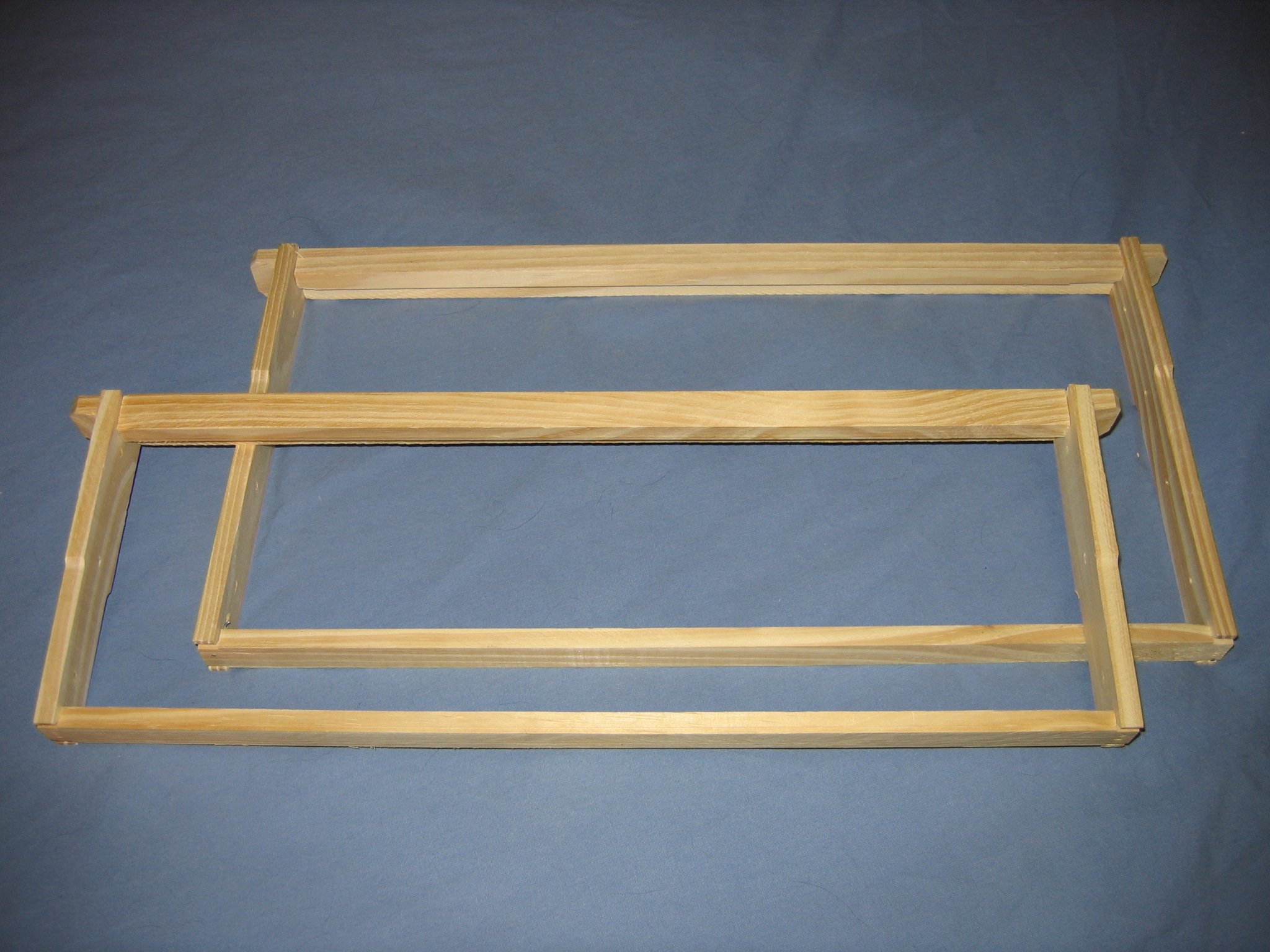
A standard Langstroth hive in Polish use typically consists of a bottom board, one or two brood boxes (deep supers, 240 mm in height for the Dadant variant or 232 mm for the Polish standard box), honey supers of half-depth, a crown board, and a roof. Frames are 435 × 300 mm (Polish standard) or 435 × 230 mm (shallow). Each box holds ten frames with wired wax foundation.
Bee space: The 6–9 mm gap between comb surfaces and hive walls that prevents bees from sealing components with propolis. Maintaining it is the central engineering requirement of any movable-frame hive.
Langstroth Frame Dimensions in Poland
Polish beekeepers use several Langstroth variants. The most widespread are the Dadant-Blatt (DB) and the Wielkopolski (WP) formats. These differ in internal box depth, which affects the brood area available in spring and the number of supers needed per season.
| Format | Frame width (mm) | Frame height (mm) | Frames per box |
|---|---|---|---|
| Dadant-Blatt (DB) | 435 | 300 | 10–12 |
| Wielkopolski (WP) | 360 | 260 | 10 |
| Standard Langstroth | 448 | 232 | 10 |
The Dadant brood box provides more laying space per box, which can reduce the need for a second brood box during summer peak. The Wielkopolski format is lighter per box — an advantage when moving hives to pollination sites — but may require splitting the brood nest across two boxes in productive years.
Top-Bar Hives
A top-bar hive (TBH) replaces vertical stacked boxes with a single horizontal trough. Bees build natural comb hanging from wooden bars placed across the top of the cavity. Unlike Langstroth, there are no full frames — only the top bar is provided; the rest of the comb is free-hanging.
Top-bar hives are less common in Polish commercial beekeeping but are used by hobbyists interested in minimal-intervention management. The main practical differences compared to Langstroth:
- Comb cannot be run through a centrifugal extractor without cutting it off the bar; honey is either cut-comb or pressed.
- Inspection requires less lifting — no supers to remove — but is slower per colony because each bar must be checked individually.
- Natural comb cell size is built by the bees; foundation is not used. Some beekeepers consider this beneficial for small-cell theory, though the evidence base remains limited.
- Winter performance in Polish conditions is variable. The long horizontal nest can develop cold pockets between the cluster and remaining stores if the colony does not move laterally when stores on one side are consumed.
Choosing Between the Two Designs
For most beginners in Poland, a Langstroth-compatible hive (Dadant or Wielkopolski) is the practical starting point. Equipment, frames, and foundation are widely available from Polish suppliers such as Pasieka Swojska and regional apicultural cooperatives. Service exchange among beekeepers — borrowing supers during flow, splitting equipment between apiaries — is simpler when formats are standardised.
A top-bar hive suits beekeepers who prioritise observation and natural comb building over yield optimisation. It is also lower in initial cost: the box itself can be built from untreated wood planks without precision joinery. However, the absence of interchangeable equipment creates a standalone system that cannot interface with Langstroth colonies in the same apiary.
Practical Notes on Hive Placement
Regardless of hive type, Polish guidance from the Polski Związek Pszczelarski (PZP) recommends positioning hives with entrances facing south or southeast. Morning sun warms the entrance area, encouraging earlier foraging. Hives should be elevated at least 20–30 cm off the ground on stands to reduce moisture wicking through the bottom board during wet seasons.
Wind exposure is a secondary concern. A natural windbreak — hedgerow, fence, or building — on the north and west sides reduces heat loss in autumn and winter without blocking flight paths.